Cart is empty

Members HempNet Customer Information
Hemp Fiber Products
HEMPFIBER
Products
Products
~ Fabric & Clothing
~ Hand Bags, Diapers & Shoes
~ Canvas Tarps, Nets, Sacks, Carpets
~ Building Materials
~ Hempcrete, Stucco & Mortar
~ Fiber Board, Insulation & Tile
~ Rope & Twine
~ Art Paper & Rolling Paper
~ Biofiber Matts
More Earth-Friendly Products Than You Can Shake A Stalk At!
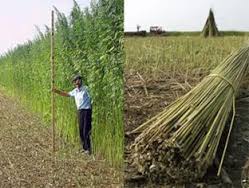
There is reported to be between 25 and 50 thousand products make from hemp fiber. That's a lot of products! This old, pre-prohibition photo demonstrates how much biomass a crop of hemp can produce. This is reported to be approximately 8 tonnes per hectare.
The bast (long, strong outer fiber) and hurd (the spongy inner core fiber) are the raw materials for processing many common household products, products that are long lasting and biodegradable, and processed without chemicals. Products that are made from raw hemp grown organically or conventionally with a minimum of chemical inputs.
Hemp plants absorb a ridicules amount of carbon to make up all that biomass. To make up the 8 tons of biomass per hectare hemp sequesters 10 tonnes of CO2. The carbon is then stored for as long as the product lasts before it is returned to the soil by naturally biodegrading or to the atmosphere through burning.
Hemp products are therefore either carbon neutral, if the carbon is returned to the atmosphere, or carbon negative if the carbon is stored for a long time, whereas petroleum products perpetually add carbon to the atmosphere and therefore are carbon positive as they take stored carbon from underground and release it into the atmosphere through burning.
Short use or single use products like paper are considered carbon neutral while long term products like hemp create or hemp building blocks are carbon negative, meaning they permanently remove carbon from the atmosphere and store lock it away. Here some detail about hemp's capacity for carbon sequestration from Good Earth Resources:
From Good Earth Resources: Carbon Sequestration of Hemp
- Dry hemp stocks contain about 44.46% carbon (C) by weight.
- 1 tonne of hemp stocks contain .446 tonnes C
Hemp absorbs CO2 via photosynthesis (PS) from the atmosphere to attain the C. PS removes the oxygen from CO2 and uses the C to build plant fiber.
- 1 tonne of C requires 3.6 tonnes of CO2 from atmosphere
- 1 tonne of hemp = .446 tonnes C
- Multiply .446 X 3.6 tonnes CO2 to get 1.6 tonnes CO2
Therefore 1 tonne of hemp fiber absorbs 1.6 tonnes of CO2 from the atmosphere to get the required amount of C needed for cell growth.
- 1 hectare of hemp yields 6-8 tonnes of dry hemp stock (2.4 - 3.2 tonnes/acre)
- 6-8 tonnes multiplied by 1.63 is = to 9-13 tonns of CO2 sequestered per hectare
- The average CO2 sequestration per hectare is 10 tonnes (4 tonnes CO2 per acre)
These figures, as good as they are, are not the whole story because they do not include the roots. Hemp has a massive root system that penetrates 1-2m, much deeper than any other commercial crop, and therefore hemp accesses nutrients not available to other crops and brings them up to the surface. Hemp is also one of the best bio-remediation plants and absorbs and removes toxins from the soil including radio-active waste. Hemp was used to remediate the soil after the Chernobyl nuclear disaster in Russia.
Since hemp stores such vast amounts of carbon, hemp building products are the best products for long term sequestration. Hemp panels will last for the duration of a building. Making both exterior and interior walls from hempcrete or hempcrete blocks can put the carbon away virtually forever. This is because hemp, lime and water, the raw materials for hempcrete, set up a chemical reaction that requires CO2 and this reaction is perpetually continuous. According to a Green Building Canada report, this results in approximately 110 kg Carbon sequestered per cubic meter of wall.
- Hempcrete perpetually stores 110kg of carbon per cubic meter.
There is no other building material that can store this amount of carbon. The price, ease of use, clean and safe, non-toxic hempcrete is by far the best product for home and small scale construction. Hempcrete is also inflamable, mold resistant and breathes moisture therefore requiring no vapour barrier.
While hemp textiles, clothing, rope and paper, are the most noted hemp products there's an endless number of products either made from hemp, or that could be made from hemp bast and hurd fiber. Hemp products benefit people and the planet because they are safe and non-toxic. They can be used to replace many of the plastic, petrochemical and wood fiber products that are causing environmental pollution and climate crisis.
 At HempNetMarket we believe that Hemp fiber products are part of the green sustainable solution. But it can only be successful if:
- people demand truly organic earth-friendly products,
- that last a long time,
- that are produced locally for local consumption,
- that are part of a biodegradable, circular system.
A sustainable future requires that most products in common use are bio-degradable and part of a green renewable circular economy. This goal is both attainable and completely necessary but requires a transition and restructuring of the manufacturing sector to using hemp fiber as a manufacturing feed stock.
Since hemp is an agricultural raw material, and it is not cost effective to ship hemp stalks, it requires primary production at or near where it grows. This adds important business opportunities in rural communities and will have a positive impact on the local economy.
Is hemp a fiber source to provide the feed stock for a Green Economy? Well it seems like the perfect solution staring us in the face, but it will take people demanding a safe, eco-friendly solution to move the program forward!
Hemp Bast: Longest - Strongest - Lightest Natural Fiber:
The exterior xylem and phloem of Hemp's make up the strong bast fiber. These cellulose fibers are extremely long and strong and great for making rope and twine. Hemp processors also use the bast fiber to make textiles, clothing, paper, diapers, hand bags, sneakers, fine fabrics, insulation, growth medium, bio-fiberglass, fiber board panels etc. This list goes on and on and new technologies are finding ever increasing use for this amazing natural fiber.
Hemp Hurd: Super Absorbent Natural Fiber
The interior pulp of the Hemp plant is called hurd and it is super absorbent (which includes both moisture and sound absorption) and has a high insulating R value. It is made into acoustic ceiling tiles, insulation, horticultural germinating mats, added to cinder blocks, and mixed with lime to make hempcrete (a type of no cement concrete that breaths moisture), made into building blocks......and much much more.
Hemp Life Community Network: Blog, Magazine, Podcast
 HempLife Magazine
 HempLife Blogs
Ad Space
Place Your
Ad in This
Margin
Hemp E-Commerce Community Marketplace
Hemp Business Advertising, Sales and Marketing Platform
Hemp Earth Friendly Bio-products, Supporting a Local Circular Bio-Economy

